











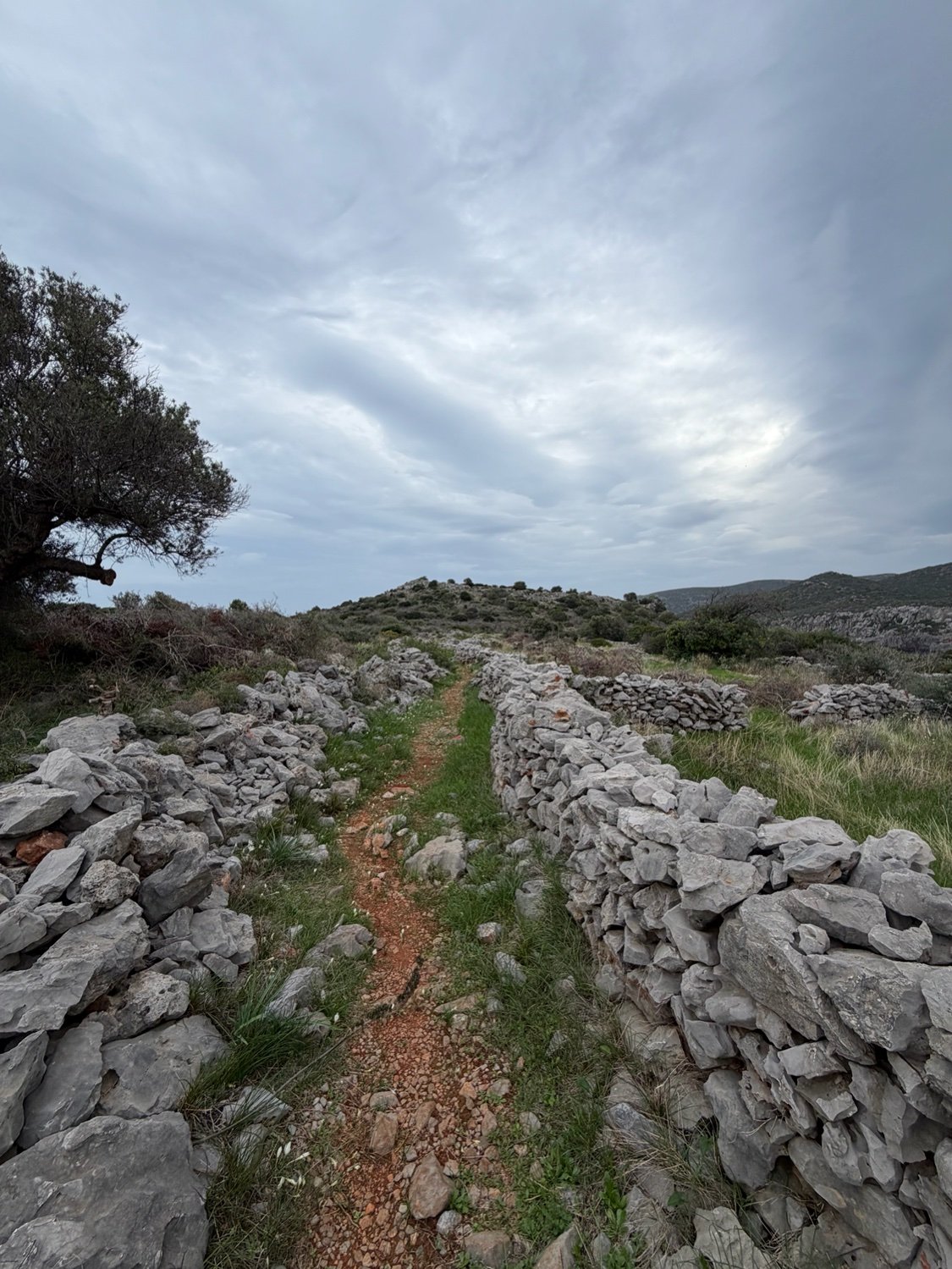

Walking the lanes of ancient Zarax. Between dry-stone walls and wild grass, a narrow path crosses the ruined town — a reddish line of earth and small stones, hemmed in on both sides by walls of loose gray rock. On the right the stones are stacked in a long, steady line; on the left they have tumbled into a rougher heap. Grass grows thick between them, small white wildflowers dot the edges, and a single dark tree leans in from the left under a heavy, clouded sky.
A town inside its walls
This is not a street in the modern sense. It is a lane through a place that was lived in, abandoned, and rebuilt more than once. The great fortification walls of Zarax still stand to a great height on the north and west of the site — irregular polygonal masonry, block fitted against block without a straight line anywhere. The city wall and the separately fortified acropolis on the east side were reinforced by eight rectangular or square towers, while the east itself needed no wall at all: a steep slope did that work.
Inside those defenses, life went on for a very long time. The walls and the buildings within them were repaired again and again through Roman and Byzantine times, because this hill above the harbor was worth holding. A vaulted Roman-period building still stands inside the walls, preserved to a great height, and the remains of a three-aisled basilica lie within the acropolis — signs of how many different centuries called this same hill home.
Why the hill mattered
Zarax guarded a small, sheltered harbor on the eastern coast of Laconia, and its strength was tested. In 219 BC, King Lycurgus of Sparta stormed town after town in a single campaign — and was turned back at Zarax. A place that could refuse a Spartan king was a place worth repairing, and generation after generation did exactly that, patching the old polygonal masonry and keeping the lanes open.
Today the only traffic on this lane is on foot. The path runs on between the stones toward the low, scrub-covered hills, and the whole ruined town is quiet around it. Walking it slowly, stone wall by stone wall, is how the size of ancient Zarax sinks in — not as a plan on a page, but as a distance your own feet have covered.
Photograph originally shared by @mouries.photography on Instagram — see the original post.